

Introduction: The Day a Minute Went Missing
Picture the morning rush. A picker waits, the line builds, and a quiet sigh fills the aisle. The pallet stacker stands ready, yet blocked by one tight turn and a slow manual lift. In one site we studied, a five-minute delay repeated eight times a shift (yes, only minutes) became 40 minutes lost—about 5% of daily capacity. So we must ask, with respect and care: if small choices create these losses, can small upgrades erase them? Kindly consider the floor: tight racks, mixed pallets, changing SKUs. The data shows more stop-and-go than actual lift time. Even the lift mast may be idle while people read labels. That is costly. And it is avoidable. Shall we look at the friction points, step by step, and see what truly moves the needle—without drama but with clarity? Let us move from scene to causes, and then to choices that matter.

Hidden Friction in Everyday Lifts
Where do old methods fall short?
We look at the classic path versus an electric stacker forklift through a technical lens. Traditional units ask the operator to manage many micro-decisions: angle, load center, approach, and clearance. Each pause adds seconds. The lift mast may be fine, yet the traction motor fights tiny surface slopes. With no tuned power converters or torque control, energy spikes and then sags. The result is choppy motion. Look, it’s simpler than you think: when the control loop is open, stability is the operator’s burden—funny how that works, right? Add paper-based slotting and no live WMS signal, and misroutes rise. Older rigs often lack a clean CAN bus layout, so diagnostics are slow. Regenerative braking is weak or absent, which wastes downhill energy. All these are small losses that pile up into late picks and tired teams.
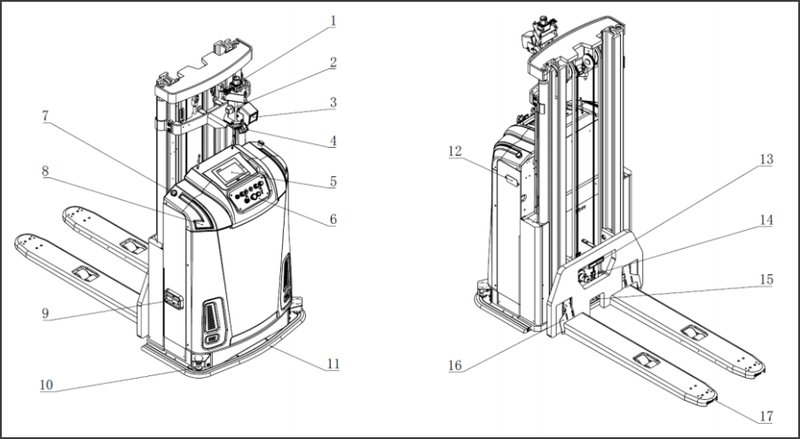
The pain points hide in plain sight. Batteries run low early because the battery management system is basic, not adaptive. Narrow aisles squeeze visibility, so operators creep, not glide. When the load center shifts mid-turn, confidence drops. People slow down, even when the schedule says speed up—and that’s okay. Safety first. But productivity still slips. Maintenance adds its own tax: if sensors are not modular, a simple fork carriage check becomes a half-day stop. Multiply that by a week, and you see the silent drain. This is why many sites feel busy but remain behind target at day’s end.
From Principles to Practice: What the Next Wave Looks Like
What’s Next
Forward-looking systems change the control layer, not only the chassis. Modern designs place edge computing nodes near the drive and lift circuits. They process sensor fusion on-board, then feed a clean CAN bus for tight motion control. The result is smoother approach and safer stacking at the same time. A current-generation electric stacker forklift can shape torque by millisecond intervals, coordinate the lift mast with travel speed, and recapture energy via regenerative braking. This is not marketing fluff; it is about physics and timing. Micro-shaping power via better power converters stabilizes the truck under mixed loads. And when the WMS nudges slotting in real time, the path feels shorter—because it is.
Comparatively, think of two sites with equal volume. One runs manual checks and fixed charge windows. The other uses a smart BMS, live pick priorities, and event-driven maintenance. The second site sees fewer mid-shift stalls, fewer battery swaps, and less idle drift at corners. Over a month, the gains look like hours added back to the day. When choosing an electric stacker forklift, consider an evaluative lens: 1) Control fidelity: does the system integrate sensor fusion and stable CAN bus loops for consistent load center control? 2) Energy model: does the BMS pair with regenerative braking to cut charge events and peak draw? 3) Service design: can edge modules and sensors swap fast with simple diagnostics? These are plain questions, but they decide your real throughput. In the end, the quiet wins compound. Teams feel calmer. Schedules breathe. And the lift does what it should—work with you, not against you. For further technical insight, you may visit SEER Robotics.


Leave a Reply